


Description
Billet
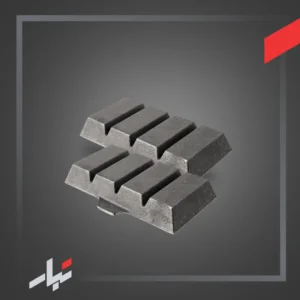
Billet is a key raw material used in the production of high-quality metal products across various industries, including metallurgy, construction, metalworking, and casting. Typically, billets have a square or circular cross-section with a rectangular width of less than 15 cm. They are commonly produced through melting and continuous casting methods. Once solidified, billets undergo further processing such as rolling or forging to reach the desired final shape.
Steel billets are categorized into different grades. Two commonly used grades in the category of carbon steel are:
– 3SP
– 5SP
These billets are generally used in applications where extremely high strength is not required. The 3SP billet offers greater flexibility, making it suitable for industries that involve bending and drawing processes. In contrast, the 5SP billet, with lower flexibility, is ideal for applications not subject to significant force or pressure. Typically, 5SP is used for rebar production, while 3SP is preferred for manufacturing beams and angle bars.
Billet features and uses:
– Consistent and uniform structure
– Available in various dimensions based on industry requirements
– High dimensional accuracy
– Cost-effective for large-scale production
– Widely used in the steel industry for manufacturing angle bars, channels, pipes, and structural profiles
– Applied in the automotive industry for producing various vehicle components
Slab
Slab is another essential raw material in the steel and metal industries, mainly used in the production of flat steel products such as sheets and structural steel components. Slabs are a type of steel ingot formed in large, flat, rectangular shapes with varying thicknesses. They are typically manufactured through continuous casting, where molten steel is cast into continuous blocks that are later cut into slabs. These slabs are then processed through hot or cold rolling to produce steel sheets, plates, strips, coils, and other finished products.
Slab features and uses:
– Shape and Size:
Slabs usually have substantial thickness and rectangular cross-sections, though exact dimensions may vary.
– High Quality:
Slabs are produced under strict quality controls, ensuring high precision and consistency in the final products.
– Cost-Efficient:
Mass production of slabs helps reduce manufacturing costs for downstream steel products.
– Widely used in the construction and automotive industries.
– Ideal for manufacturing various flat steel products, such as hot-rolled sheets (ST37 and ST52), steel plates, and coils.


Reviews
There are no reviews yet.